Risk of Crushing?

One of the great fears of employees and investors at some startups is that they get crushed by an adjacent giant competitor. Yet I’d observe that, in most cases, founders feel that risk less strongly. Why? And who’s right?

Back in the day (late 80s / early 90s), Microsoft were seen as the “fast follower” masters, copying ideas from startups, absorbing the functionality, and rendering the startup irrelevant. It was said that Microsoft executives would brief venture capital investors on what they (Microsoft) were interested in, so that the investors could avoid putting money into any competing venture. It was also said that Microsoft would confront startups with a “sell out cheaply to us, or we’ll copy what you’ve done” Hobson’s choice. Microsoft certainly ran a lot of their corporate strategy with reference to beating competitors – focussing on outplaying Lotus, IBM, Novell, Netscape, Sun and all the rest. It was a remarkably successful approach for a long time; Bill Gates once said, while looking at the exhibits in the Computer History Museum, that the museum might have dedicated itself to preserving the memory of Microsoft competitors for posterity.

Of course, things have changed since the ’90s. The consumer has taken over from corporate I.T. as the driver of the tech industry. The consumer is more diverse, faster to try something new if it sounds exciting, and less conservative than I.T. departments. Cloud-based services with web APIs are easier to mix-and-match than 1990s-era large-scale software packages. And mobile devices place a premium on simplicity, not breadth of features.

Unable to rely on I.T. conservatism to give them a chance to catch up, even the largest tech companies have been pushed more towards organic innovation, Microsoft’s brilliant Kinnect (controllerless gaming) product being a fine recent example.

Even so, the fast-follower strategy is not dead yet. The primary current example is FaceBook. At FaceBook’s foundation, it borrowed liberally from Friendster and MySpace. Later it “borrowed” from Twitter (short posts), Foursquare (FaceBook Places), Quora (FaceBook Questions) – and so on.

The difference now is that these companies have not been “killed” as a result of being followed. Twitter’s course is set fair for an IPO – though its growth was slowed, and FaceBook’s accelerated, by FaceBook’s adoption of many Twitter ideas. Foursquare are powering ahead. FaceBook Questions has not received a fraction of the attention of Quora.

Yes, it is often possible, at a startup, to become very concerned with “Well, what happens if Microsoft/Google/Apple/FaceBook/IBM… does X”, and to imagine all kinds of horrible scenarios. And running scared can be one way to give everyone in a startup the necessary sense of urgency – including any founder who might believe a little too strongly in their own invincibility. But in reality, chasing an innovation is hard, especially once the innovator has become strongly identified with the innovation in question.

This seems consistent with most startup founders’ intuition – more often than not, it is the startup, not the competition, that determines success of failure. Is the product compelling to ordinary users, is the team right, is the quality there, do users love and bond with the user experience, does the financial plan hang together, is the offer communicated succinctly and compellingly? Those are the things that make the difference.

2 Comments

Filed under Tech

Founder CEOs

The old saw in Silicon Valley used to be – “It’s never too soon to fire the founder.” Founders wouldn’t know how to scale; they would focus on product or technology, not business; they would have idiosyncratic and unrealistic strategic opinions that they wouldn’t let go off; they would fail to delegate; they would be inflexible; they wouldn’t know how to work with a board; they wouldn’t have credibility with investors, or customers, or media, or senior executive recruits; they would have an exaggerated opinion of their own indispensability; they would allow chaos to reign over process. And so on.

Google’s board certainly had some of these factors in mind when they appointed Eric Schmidt CEO ahead of Google’s IPO. Yet, the trend recently has been more in favor of keeping the founder as leader. Why?

Partly, it’s data.

Apple has provided almost a laboratory test-case of the benefits of a founder’s opinionated micro-management vs. the benefits of “professional” “seasoned” executives.

Mark Zuckerberg is the next data point. Here he is giving one of the sweatiest most embarrassing media-interviews ever at D8. Kara Swisher (All Things Digital / WSJ) called him the “Toddler CEO”. He was – and is – very young. Yet Facebook has only gained in strength, Swisher had the good grace to call Zuckerberg a “prodigy“, and no-one now imagines that Zuckerberg would stand aside prior to a FaceBook IPO.

Going back to ancient history, Bill Gates was always the exemplar of the founder-CEO – though he had the advantage of Microsoft growing more slowly in its first decade than Google or Facebook, making it easier to gain credibility over time.

What is it about founder CEOs that sometimes allows their companies to outperform?

It’s two things: The singularity of vision and drive; and the singular source of authority.

Vision and drive first. In the (bad) old model, venture investors would “take” the founder’s idea and build a company out of it. But it turns out that it is not so easy to take an idea away from its originator without diluting it. Imagine if “professional management” had been running Facebook – they would have had monetization at the top of their agenda. Instead, Zuckerberg has been getting up every day and wondering “How can we improve and deepen Facebook for our users?” It’s all about the users, unrelentingly. And with Facebook showing another huge surge in usage in 2010, that turns out to be the thing that drives success.

Then authority. One of the hard things in companies with lots of smart people is actually making decisions and having them stay made. A judicious “professional” CEO will listen to the evidence and then decide. But the problem is that they are highly dependent on what evidence staff bring them, and can and do change their minds if the information in front of them changes. A founder CEO will – hopefully – also look at evidence, but in a great many cases they know what the right decision is, what direction they want to go. They may sometimes be wrong, but the definiteness of their decision making is, in fact, a huge asset.

Can Google regain these positives by reappointing Larry Page as CEO? I must admit I’m a little more skeptical than most commentators out there seem to be.

Firstly, there’s the question of the extent to which Eric Schmidt was always window-dressing. There was a TV interview (sorry, I can’t find a link) where Eric was describing the Erc+Larry+Sergei triumvirate at the top of Google, and the interviewer tried to put him on the spot by saying, “But what happens when you can’t agree with Larry and Sergei?” An unembarrassed Eric shot back with “We do what they want.” Which does rather beg the question of who was really directing the company.

Secondly, in another context, Eric provided an example of how he applied his experience within Google:

[Google’s Intuit accounting system] was too slow to use, so I suggested that they implement an Oracle system. It was a huge crisis. We ended up spending $100,000 for this. Larry and Sergey nearly had a cow over it (because they thought it was so expensive). A hundred thousand dollars is the cheapest Oracle system ever implemented in history I think.

But I find this example unconvincing. Of course, Larry and Sergei did not have experience of the accounting systems that would be needed as Google grew. Yet, it is often possible to put excellent operational executives around founders who can drive things of this kind; look at Tim Cook at Apple, to cite just an obvious example. Eric didn’t need to be CEO to solve this kind of issue.

So why the skepticism about Larry regaining the CEO seat? Essentially, the executive management challenge that Google has is that they have not been able to sharpen and focus their efforts to grow beyond their wonderful core business, leaving them now at risk of being outflanked by FaceBook, Groupon or others. With Larry deeply invested in their existing bottoms-up try-it-and-see-what-sticks algorithms-are-best approach to new initiatives, it seems tough to imagine that he will provide the visionary leadership to extend Google successfully – even if he proves superior to the triumvirate as a steward of their existing franchise.

Sometimes – perhaps even most commonly  – founders really can’t fill the CEO role as a company grows. But today at least boards may remember how much they give up when the move a founder aside.

1 Comment

Filed under Tech

Cloud Infrastructure

Shorter post today, was out on my bike this morning, up to Skyline and down a couple of times. By the way, as I rode down past the redwoods on one tiny apparently-deserted lane, a guy stopped me and had me take a picture of him and his wife alongside their new Ferrari, using the Santa Cruz mountains as backdrop. Very Silicon Valley…

Anyhow, if I may quote myself, back on Jan 6th, I had a tweet:

Duncan Greatwood Web bad lately? #Skype #Hotmail #Twitter #LinkedIn (today!)#Google -calendar flaking. Can we fix cloud? http://bit.ly/ggnbzv #perfectstart via Twitter

I might have included Tumblr, which is not working again today. Or Twitter itself – the Tweet above could not be pulled directly from Twitter due to overload, I had to pull it from LinkedIn…

What’s wrong with cloud/web infrastructure?

The main issue is that running a truly large infrastructure involves a lot of layers, a lot of complexity, a lot of custom work pasting things together, a lot of less-than-100%-perfect components (software, load-balancers, hardware…), and a lot of diving-catch human intervention.

One requirement to get it fixed is a standardized, integrated, automated solution.

Amazon announced their “Elastic Beanstalk” service today, which is an attempt to package together Amazon Web Services in a more pre-baked way.

OpenStack and Eucalyptus are both examples of attempts to build a pre-packaged web infrastructure.

The “DevOps” movement – is it big enough to be called a movement yet? – also fits here, with their attempt to break down the barriers between application software development and cloud infrastructure management.

Although some people, such as those mentioned above, have made a start, there’s a huge amount still to do here. The width and depth of the stack is much greater than anyone has tried to tackle yet. The stack would defacto reach into core application software development libraries and methodologies (which is in part motivating VMWare’s push to developers).

As a startup area, it has some challenges.

Almost by definition, the integrated stack market will in part be a market for comprehensiveness – whereas small companies often find it easiest in markets that benefit from focus.

Second challenge – the really big cloud operators have their own stacks, often messy and the result of historical accident, but nonetheless hard to displace.

A startup in the space might to do best to target enterprise clouds, at least initially.

Another tactic would be to go after the as-yet-unintegrated parts of the stack, to be complimentary to OpenStack, VMWare, or Eucalyptus, in an attempt to narrow the initial scope of the problem. If done right, this might have the double benefit of making it applicable sooner to the large-scale cloud companies – Facebook, LinkedIn, Twitter and all the rest – if it tackles the automation of something they haven’t well-automated already themselves.

When I have some time for a little more in-depth write-up, I’ll sketch out what “the stack” consists of.

[Hat-tip: There’s a nice stream of comments from commenter “M K” on LinkedIn against my original Tweet, for those who are connected to me on LinkedIn]

1 Comment

Filed under Tech

How To Name A Startup

Product-minded people rarely enjoy naming discussions. What’s the problem?

Anyone can – and does – have an opinion on naming and branding. In comparison to engineering, or even sales, it is challenging to know what weight to give one person’s opinion vs. another’s when it comes to naming.

“All the good names are taken.” How many times have I heard that during naming discussions?

Naming introduces philosophies of marketing, whether it’s brand-hierarchies, focus-group testing, or whatever, to product-creators who may secretly, or not so secretly, regard them as pure babble.

Naming discussions reveal how others feel about a company, and shows founders that they don’t own how their company is seen – an uncomfortable feeling, even if others’ views are positive.

How do great names get chosen?

It’s quite random. Doing it early seems to help. Brainstorming around a lunch table is as good a method as any…

For instance – Google got it’s name when some grad students, talking to Larry Page about the amount of information his company would need to process, mentioned a “Googol” (10100, about one-hundred-billion times a billion times the number of atoms in the universe), and then Larry mistyped Googol as Google.

Nike got it’s name from the – very obvious – Greek godess of victory. The swoosh was early, too.

Starbucks’ name is of course taken from Moby Dick’s “Starbuck”, the first-mate aboard the Pequod; the nautical reference was a tribute to coffee shippers. The logo was drawn by an artist friend of the founders.

So, what are the lessons? Choose early, to reduce the number of people who have to be involved. Choose something simple, easy to spell, and with an available or obtainable web URL. That may mean a made-up word, since, indeed, “All the good names are taken.”

And choose something that, while it can “mean” something to the founders, doesn’t mean something so specific that it prevents the company defining its own identity; because the only thing worse than a naming discussion is a renaming discussion.

Starbucks illustrate the last point perfectly. Starbucks is indeed simple, memorable, and easy to spell – but when they added the word “Coffee” to the logo, they boxed themselves in in a way they have come to regret.

See, among many, Forbes discussion of Starbucks recent logo change.

[Additional hat-tip: ReadWriteWeb, What’s In A Name?]

1 Comment

Filed under Tech

Twitter’s Who-To-Follow Directory

We discussed here the lack of  personalized-trends mechanism in Twitter. This seems to be something holding Twitter back from becoming a more broadly applicable system – it makes Twitter a weak personal communication and information system (unless your personal homepage is TMZ, anyway).

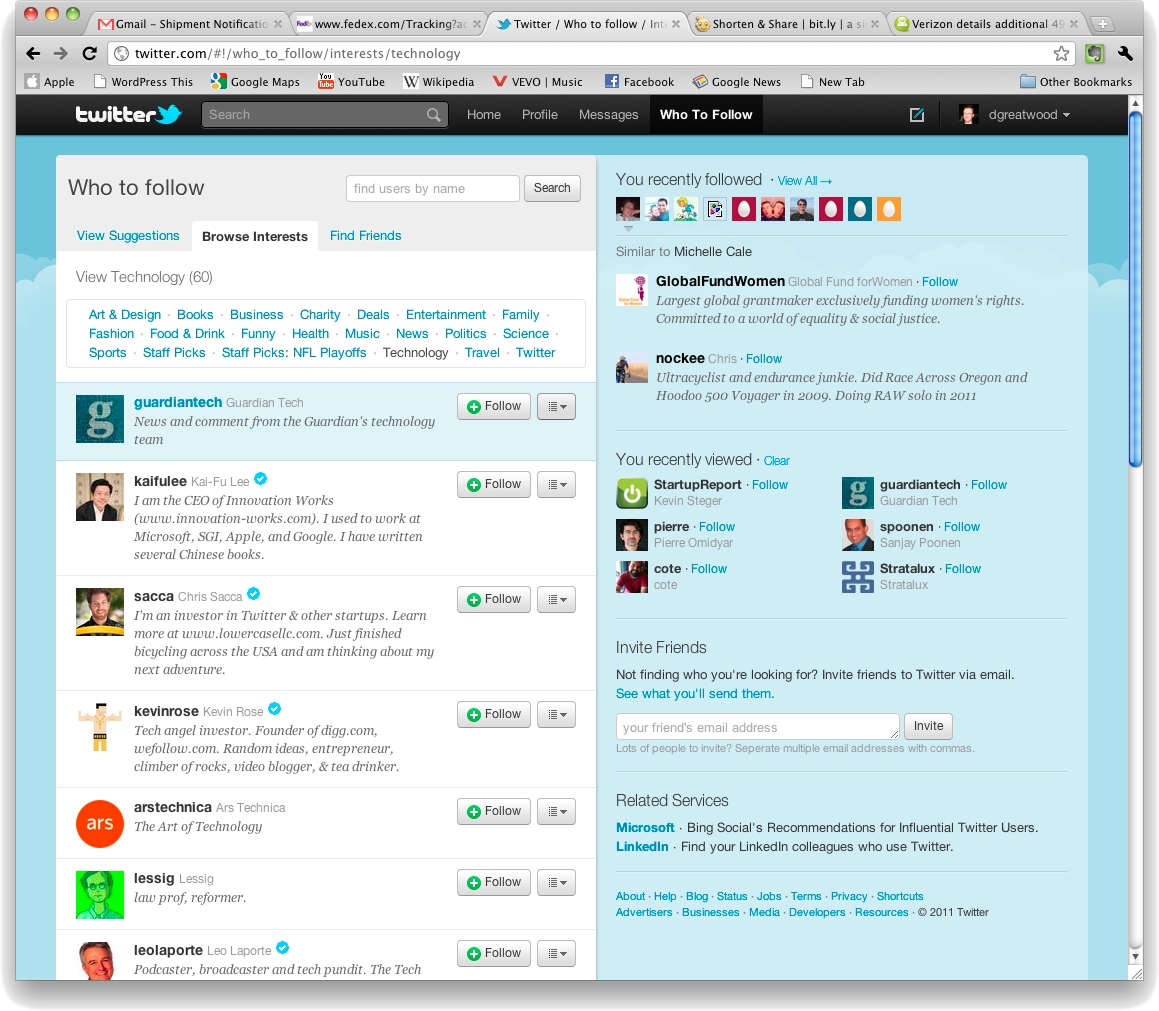
In fairness, Twitter does provide a “Who To Follow” directory. Here’s an example for the “Technology” area of interest:

The selection mechanism seems to be number of followers. This is fine as far as it goes – though it does remind me of those old Yahoo Internet directories from the late 90s.

It doesn’t give you any sense of what is going on today amongst your slice of the Twitter community. It is rather static. It feels a little like a newsservice, a little top-down.

On Techcrunch, commenting on the UserStreams of Twitter for MAC, MG Siegler wrote:

[…] when you actually start to have a conversation with people and can see them responding to you in realtime, it becomes more like an IM service instead of the way we’ve typically viewed Twitter: with static one-off messages and maybe a reply here or there.

So Twitter-for-MAC comes closer to the idea of seeing your personalized and relevant community on Twitter in action – but it is purely real-time vs. taking advantage of trending, and only looks at your direct followees, too.

Is there an entry-point for a startup between UserStreams and traditional Twitter trending?

3 Comments

Filed under Tech

As Much WiFi As You Want

Coverage of iPhone-on-Verizon comes down to:
The Biggest Surprise About the Verizon iPhone: It’s a Mobile Hotspot

The coverage assumes that AT&T will be forced to follow-suit, sooner or later.

Most of the coverage to date has focussed on the impact on “MiFi”, that is mini cellular-to-WiFi converters.

But the impact is likely to be much broader – it means (eventually) that, wherever you go, you will have WiFi – you can have 10 continuously-connected WiFi devices if you like. No need to have 10 cellular subscriptions, all your devices will channel their connectivity through your cell-phone.

Of course, this will have to be managed efficiently, so that all those WiFi devices don’t drive your cell phone’s battery to dust in no-time.

What new startup opportunities get created once the marginal-cost of additional 3G/4G cellular access is zero?

Comments Off on As Much WiFi As You Want

Filed under Tech

Personal Trends in Social Media

Getting More Relevant

I’ve been writing about how email might evolve in light of newer ways of communicating (IM / SMS and FaceBook):
https://myperfectstartup.com/2011/01/12/email-and-social-walls/

In that email article, we saw some of the ways in which modern social tools, especially FaceBook, find the messages you want to read, helping senders (who don’t have to address their message so carefully, if at all) and receivers (who don’t have to sort through a large Inbox looking for relevant items).

While walking the dog yesterday – yes, life is tough for us might-do-it-again second-time founders – a related thought came to me.

How could we improve the relevance of the communications presented to a user?

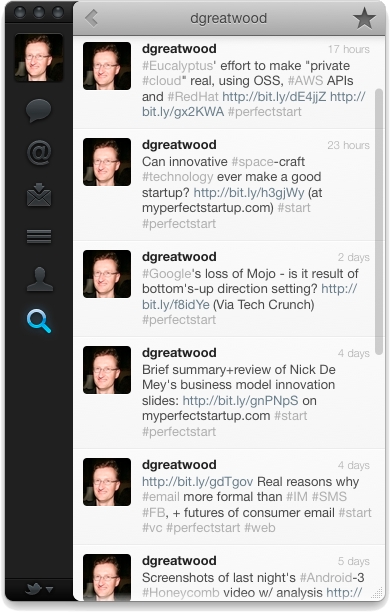
Right now, these are the trends Twitter is showing for me:

I think it’s fair to say that the relevance of #youneedanewboyfriend to me (43-year-old heterosexual married man since you ask) is pretty limited. This list doesn’t seem to reflect the technology-related topics I mostly tweet about. What could we use to personalize the trending lists (i.e. find relevant topics)?

  1. Things I tweet about
  2. Tweets I click on
  3. Things the people I follow tweet about (best when following a significant number of people)
  4. Things the people who follow me tweet about (best when there are a significant number of followers)
  5. Second-degree-of-separation topics – tweets from the followers and followees of my followers and followees; tweets on topics from people who tweet on the topics that are already known to be relevant
  6. Local tweets (Twitter already trying this, see the “Worldwide change” button under trends, though it is not a great feature today)

How does this link back to Email? Right now, Twitter is more of a publication than a two-way-communication tool. Yet, by achieving better relevance, it could be something where your replies are as important as initiating a new thread. FaceBook is already part way there, in that they look for relevance by your interactions, but of course they can’t/don’t look across the whole universe of communications to pull in what’s relevant.

How might this be implemented in a startup? By producing a client or clients – probably a web-client + iPhone app + Android app – that delivered access to Twitter with relevant tracking, and which helped with the people- and topics-orientation that better relevance would produce.

Over time, this startup would want to avoid being purely dependent on Twitter – always a risk to be dependent on a single vendor, who could simply try and swallow your function – by also leveraging other forms of communication, perhaps FaceBook, perhaps email. As we previously discussed, it might be possible to radically simplify (consumer) email by making more use of relevance.

How does this rate as a startup idea? I like that it is simple at the start. I would worry that others have already done it / are doing it / could easily do it. I like the idea of starting with relevance work on something (Twitter) that is not email, and then backing into email, reducing the temptation to recreate email, or recreate FaceBook. A client-side integration makes it easier to link in to multiple systems (Email / FaceBook / Twitter / …). I must admit, I’m intrigued by this one.

Anyone aware of others working on this problem? What are they doing?

2 Comments

Filed under Tech

EMail and Social “Walls”

This post is a continuation of these discussions:
Email Formality, Informality, and Email’s future
IM and SMS-like Interface for Email

Alongside instant communication systems, IM/chat and SMS, the increasingly dominant metaphor for communication is the (FaceBook) “Wall”, thus (click on image if you want to see it full size):

Notice how very close this wall is to an email Inbox, showing a sequence of conversations, most recent first. It would plainly be possible to represent an email Inbox in this fashion; indeed, any feed that might combine email, IM, SMS, photographs etc. can be represented as a wall.

While noticing the similarities to an email inbox, we should also note the simplifications vs. email:

  • Although, as you FaceBook user, you can go look at the walls of others, and post there if you have authorization, most users spend most of their time posting on their own wall, and relying on FaceBook to relay the post to their friends’ walls. Thus most messages on FaceBook are available to all friends and do not need to be addressed.(*) Twitter represents an even more extreme example, where all messages are available to the whole world.
  • There is no read/unread metaphor, unlike email, messages just scroll out as they age.
  • There is no guarantee that a given message, posted by a friend to their wall, will show up on your wall – FaceBook automates the selection of which friends’ posts appear on your wall based on how many “wall interactions” (that is “conversations” in email terms) you have with the person. In other words FaceBook removes from the user (part of) the need to select the most relevant messages from the flood of possibly-relevant ones. Twitter addresses this somewhat differently, by tracking topics that are getting a lot of attention, and promoting them. It would of course be possible to combine the approaches, promoting both active topics and close friends.

Here’s a comment (via LinkedIn), on yesterday’s post, IM and SMS-like Interface for Email:

M K:
I think for consumers, FB has this figured out mostly. It has photo sharing, IM, simple status updates, simple messaging, some sort of functionality that allows for planning social visits, etc. It’s like internet for people who don’t want to have to use the internet.

For the most part, I think this is right (leave aside the comment’s concluding rhetorical flourish about the Internet) – the “Social Wall” is an effective substitute for an Email Inbox. A social wall can even provide directed messages, and long-term searchability, albeit those things are not emphasized. It can cope with long messages by truncating them – indeed, it could deduce that a sender whose longer message is expanded by the reader deserves a higher relevance score than one whose longer message is not expanded.

All that said, there are still special features of email:

  1. The expectation that your message will be read
  2. The universality of email (almost everyone has an email address)
  3. The presentation of an Inbox allows the display of a larger number of conversations – my Inbox is currently showing 31 conversations vs. 5 for my FaceBook page in the same screen area. This is partly a “bug” in Email – displaying so many conversations is a mechanism for allowing the user to sort them rapidly, which would be less critical if Email would help select what is of interest to me automatically – but it is also a feature, especially if reason #1 looms large and/or automatic relevance determination is difficult for a user.

I would suggest that, but for reason #2 – universality – many users would be able to abandon email completely, at least in their personal lives. Yet, universality of email is likely to persist for a long time.

Would there be value, then, in turning this around, and providing a wall-like and person-oriented experience for Email, that dramatically simplified the email experience for most users but retained, in some way, special features? The answer is almost certainly “Yes”, the benefits being: i) Turning email from a chore to a pleasure; and ii) Allowing you to connect to anyone via your favorite wall-based communication metaphor.

We may return to how this might be achieved. 🙂

2 Comments

Filed under Tech

IM and SMS-like Interface for Email

This post follows on from: “Email Formality, Informality, and Email’s future“. How might Email adopt some of the informality of other systems?

Let’s start by looking at a simple IM session (this is the Skype client):

Here we note a key feature vs. using an email client: The threads are purely person (or group) oriented. If you open a contact, you simply see all your IM communication with that person/group, no subdivision by subject or anything else. Similarly, you are not called on to add side-copies (CCs). The way in to the interface is simply a list of contacts (or “friends” etc.) – you choose the person you want to communicate with, and off you go. This minimizes formality by maximizing simplicity.

We can see a similar minimalism in Twitter, though the communication style is different:

Also worth noting is that the Skype IM client makes it easy to switch to another mode of communication (video). In a more integrated client experience, IMs, Email, Video Calls, SMS would all be part of the same simple thread with this contact.

Of course, IM and (even more so) SMS also create a real-time “please answer right now” element, initiating a conversation, while an email is longer, more self-contained, and implies permission to provide a delayed response. It would hard to provide a reliable real-time conversation via email protocols – though delivery can be near instantaneous, delays of a minute or so are not uncommon. Accordingly, a very-simple-email client might need to be a combined IM-and-Email client (or even Very-Simple-Email+IM+SMS), automatically selecting IM or email as the case might be, but retaining the pure-contacts orientation of tracking activities; call it a “Very Simple Communication Client”.

How could a start-up address a situation? Almost certainly not by trying to build a massive new infrastructure for email (and IM and SMS and…). Rather, it would be by building a very-simplified-client that linked to some popular existing back-ends, and then taking it from there. It is even possible that it could exist as an extension to existing clients, in some cases.

Plainly, the client would need mobile support. Indeed, one of the appeals of such a client should be that it would be naturally fit for mobile (short messages, simple interface).

The client would also need to find an efficient (i.e. simplified) metaphor for handling incoming messages.

Although building a huge new infrastructure would be best avoided to begin with, in the longer term, the client might need a back-end to anchor its value. I will return to what a future back-end might look like in a future post.

I will also delve into the topic of how an ultra-simplified-messaging might apply to social walls (most notably FaceBook of course), and Twitter.

3 Comments

Filed under Tech

Shoot for the Moon

One of our commenters was kind enough to suggest the following idea, thought I’d promote it to a post.

From: gandalfprod / EricD.

As Duncan opened the door to a next start-up idea, well, let’s think about the impossible (well, I guess you were told it was impossible for the last startup too…).

In the last years, there is a shift happening into space travel – instead of funding large national agency (ESA, NASA, etc), a few small companies have been fairly innovative and enabled to raise a fairly large amount of capital through those tough times. It would BTW be expected a fairly important of innovations will come from them –
– SpaceX – an other $50M end of 2011 on top of what has been raised before,http://www.space.com/news/spacex-commercial-space-investment-101111.html
– VirginGalatics (http://www.virgingalactic.com) , The Spaceship Company (http://www.thespaceshipcompany.com/)

Well… solar-cell engines might be the next challenge… and there is still plenty of software to write to get them to work well. Impossible?

This seems like one of those hard-to-judge-rationally areas 🙂

We really have no idea how big the market for space flight at a given price would be.

We don’t know how technically practical solar-cell engines would be.

Perhaps the best way to pursue such an idea would be to build a startup to act as a technology supplier to some of the vendors of space craft or space-craft-components?

Plainly, the challenges include – sizing the technical challenge, and getting the right team, in what may be a very specialist area; only a handful of potential customers; uncertain end-market demand; government/regulatory/disaster uncertainty. Perhaps this is one that someone would pursue more for love than money?

On the other hand, specialist producers of very-specifically-targeted technologies can be great (very profitable) businesses; Germany seems to have a special talent for them: printing presses (Koenig & Bauer), licence plates (Utsch), snuff (Pöschl), shaving brushes (Mühle), flycatchers (Aeroxon), industrial chains (RUD) and high-pressure cleaners (Kärcher). [Via: The Economist]

4 Comments

Filed under Tech