Business Model Innovation

We should remember that sometimes business model innovations are as/more important than product – Google being the greatest example of a startup that was business-model-innovation oriented.

Nice presentation from Nick De Mey from Board of Innovation, here’s what they offered up (I edited their list a bit):

  • Free service with a focus, sell the data, forget privacy (PatientsLikeMe.com)
  • Automate donations, take a cut (Flattr)
  • Groupon. Coupons. ‘Nuff said.
  • Freemium content delivery with advertising support of free (Spotify)
  • “Bribing people to ‘Like’ You” – pay for user promotion – PayWithATweet.com
  • In-app sales
  • Co-design / crowd-funding, quirky.com

Some of these are already big – In-App sales, for instance – while others, like PayWithATweet.com, seem destined to be seen as too cheesy for the mass market?

[Via TechCrunch]

2 Comments

Filed under Tech

Email Formality, Informality, and Email’s future

Yesterday, I heard a NY Times tech columnist Matt Richtel on Bay Area radio station KFOG discussing the decline of email, which he ascribed to email’s “formality”. He was referring back, of course, to Mark Zuckerberg’s comments on Facebook’s messaging system launch. You know a meme has gone mainstream when a columnist from the world’s stodgiest newspaper (sorry, guys) is interviewed about it on your local 40-something’s rock station.

Richtel (and Zuckerberg) put this down to email’s format. “There’s a subject field, a formal greeting, a closing [like “sincerely, Duncan”]. Teens are using SMS and IM because it’s much simpler,” per TechCrunch.

And of course other messaging systems want to interface into email because of its ubiquity – you can reach almost anyone via email.

There is something in the “decline of email,” certainly in consumer – Yahoo are seeing a significant fall in usage, for instance.

Yet, doesn’t the “Sincerely” explanation mostly feel like bunk? Millions of people have used short-form emails on their BlackBerry over the last decade. This is not primarily a format question.

Here are some key factors that really give email a more “formal” feel:

  • You are taking an active decision to send a message to particular person or group of people; you are investing more in emailing someone vs. putting a post on a wall where it may or may not be read by your followers or friends
  • The message is expected to be kept forever, and may be referred back to, unlike, typically, SMS/IM. Email is a medium of record (stodgy – ask the NYT!), for better and worse
  • The message can be arbitrarily long, like an essay
  • The expectation is that it will be (and should be!) read – unlike a tweets or posts, which might or might not be seen
  • As Zuckerberg rightly said, it does have more fields than just adding to an IM-conversation or posting requires
  • Email replies can be much more considered than IM, or than typical Facebook-post comments
  • Your gran does email

I would note that a lot of this is really a reflection of email’s flexibility – it can be short or long, high or low priority for reading, simple or complex content, for the young or the old, directed or widely broadcast, short-term or long-term in its implications. Indeed, part of email’s problem may be its flexibility – what really does the sender mean by sending you an email?

Remember all those “Sent from my BlackBerry” signatures? They were trying to direct the recipient to think of the email as a short-form informal message – well, when they weren’t drawing attention to the sender’s gadget prowess. An SMS doesn’t need a footer to tell you it is informally composed and sent; in a world of app minimalism, “flexible” is not always a good thing.

Is there space for a startup that does more to combine the ubiquity of email with instantaneous informal easeful feeling of IM, SMS, micro-blogging, and social spaces? Would you call it an “Instant Email” service?

I think the IM and SMS “feel” would be fairly easy to create in an ultra-simple client – one with a strong mobile + web orientation. Would this matter, though? Perhaps it would, if the user could provide a way for friends to adopt the client.

Posting is much harder. How could you remove the “I am deliberating choosing to send you this email, so you’d better read it” feeling from email, without recreating FaceBook (which would be truly pointless). Facebook already does a decent job of basic email-wall integration, for those that want it.

Then there’s the question of how video/4G impacts the future of email… Video, like email, is a attention-demanding medium (vs. a FaceBook wall). Should a re-imaging of email embrace some aspects of video?

There might be something here, but it needs more work to qualify as a startup idea.

3 Comments

Filed under Tech

The Problem with iPad Input

One way to find a startup idea is run into a problem, solve it, and turn the solution into a business.

So here’s a simple problem.

Over the last few months, I’ve been using an iPad for my “feet up” (i.e. on the couch) computing – reading, web browsing, a little light input for email, social, etc.

Then, last week I was travelling and ended up doing the feet-up computing with a laptop instead. It was a laugh-out-loud revelation how much faster and more efficient a laptop was than the iPad.

Yet, I still love the iPad for reading and certain forms of browsing. What’s the problem?

Most commentary on the iPad IO challenge has centered on the keyboard (see engadget on Zaggmate, for instance). That’s understandable in its way, since the iPad is smartphone-like and the principle smart-phone IO problem is keying.
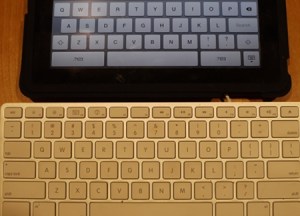
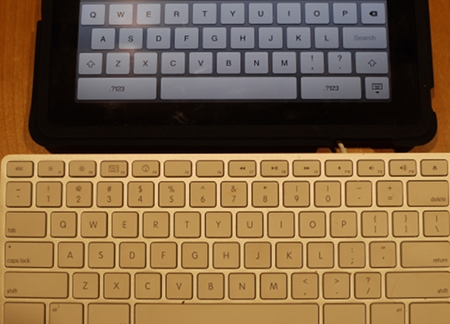
Understandable, but mostly wrong. Here is an image of the landscape mode iPad keyboard up against a full-size external MAC keyboard. Look at the size of the keys, and the distance spanned between the “Q” and the “P” – that’s right, the iPad keyboard is as big as a full-size keyboard.

The keyboard is not the main issue.

OK – so, what is it? Well, it’s the “mouse” / pointing mechanism. Here’s an example:

The user is trying to touch a link – but the links on this webpage are too crowded together for an accurate touch.

This lack of precision on a touch gesture is the root of the difficulty of navigating and inputting on the iPad.

More examples:

It’s not just links. Plenty of web-apps make their buttons too small, or too crowded, for comfortable touch access.

When editing text with the keyboard, and trying to position the cursor by touch, it is very difficult to touch in the right point in the text. This is the biggest reason I’m slower at entering text on the iPad.

When editing graphics, it is tough to select the correct pixel for fine-grained modifications – a shame, since touch is a great way of making pictures, like painting with fingers. An artist can draw the picture, but can’t touch it up. A real shame.

So – what’s the solution? Well, a bluetooth mouse would be one – but an external input seems counter-iPad, and not much of answer for feet-up computing.

Here’s something better – a virtual TrackPad (click on the mockup to enlarge). Allow the user to summon it up with a twist-3-fingers-on-the-glass gesture.

It provides a mouse pointer which is moved around just as on a conventional mousepad.

Clicking could be via a “Click” button, or simply tapping briefly on the virtual trackpad.

A “move” button is provided so that the virtual trackpad can be repositioned on the screen.

The position and orientation of the trackpad would shift automatically when the orientation of the iPad changed.

“Ordinary” touch would still be default most of the time, maintaining the maximally intuitive “touch it directly” sense of the iOS touch interface.

How implementable is this for a startup? Technology – writing the track pad software would be easy enough, the challenge would be integrating it with applications (iOS does not provide access to the low-level code that would enable a virtual trackpad at the OS level, there would have to be a library to be integrated with applications). You could build a new version of the browser, as others have for different reasons. But the requirement to provide a new/rebuilt version of every application, incorporating the special library, seems quite the barrier to adoption

In terms of business expandability, perhaps there are some apps for which fine-grained mouse control is so fundamental that a startup could build and win with those apps.

However, if fine-grained pointing proved successful, Apple could replicate it. It could be protected with patents, but who enjoys patent-driven business? And for an exit, with Apple the only obvious buyer it might be hard to drive a great price.

There are of the order of 10m people with an iPad at time of writing, with the number growing fast, so it is a decent volume market (not huge yet, but decent).

Probably 4/10 as a startup idea. More of a feature than a company, as they say. Maybe Apple could just do it for me; or if not perhaps I’ll just have to buy one of these instead.

Yet another approach would be target non-Apple tablets, especially Android. Even in Android, though, it is not possible to simply add this capability – you would either need to rebuild the key apps (as per iPad), or build your own tablet, or persuade Google and/or the device manufacturer or carrier to include your changes.

The conventional wisdom of the moment is that iPad may dominate in the tablet space. It is a sad fact that existing Android tablets are messy, inferior iPad imitations. If Android is to break out, it likely needs to innovate in user experience as well as cleaning up the interface messiness. It is possible that there are a set of user interface innovations – of which a pop-up virtual trackpad might be one – that could offer a chance to leapfrog Apple. So a broader idea for a startup would be a “fork Android 3.x and do it right” company. That might have more potential, though it would not be one for the faint of heart.

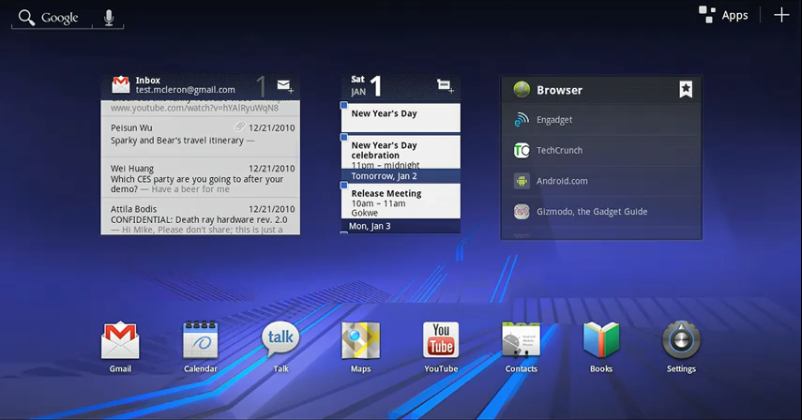
Update (Android 3.0 screenshots): Coincidentally, just saw preview video of Android 3.0 (Honeycomb) as posted by Google. What’s there?
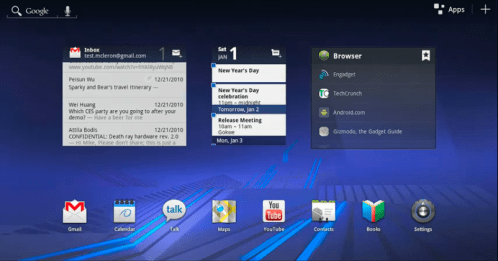
At 20 seconds (above), they show a more desktop-like tablet screen – App icons along the bottom, multiple running widgets in the upper part of the screen, like the MAC’s widgets screen.
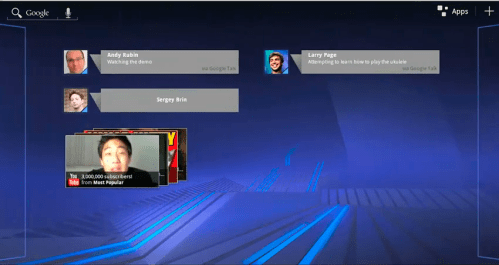
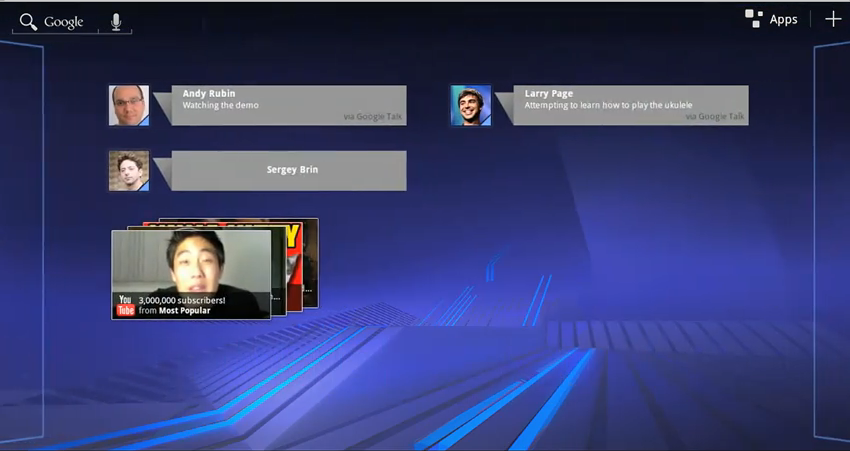
Above, you see a chat client with 3D stacking navigation.
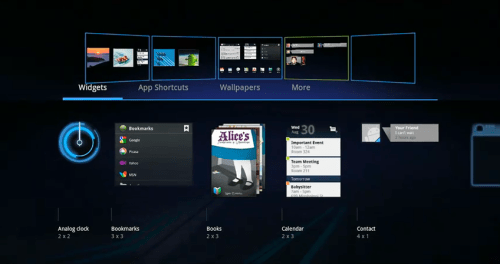
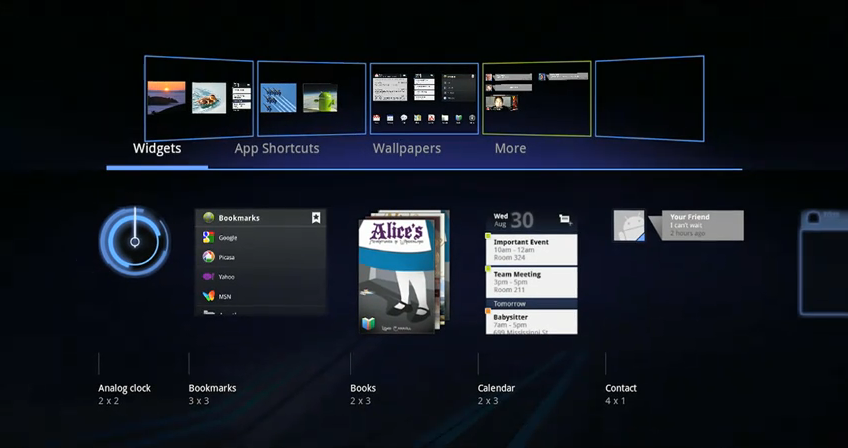
Above you see another multi-application view, with multiple widgets running and a (again MAC like!) visual navigation bar along the top. Immediately after, they show you pulling on the widgets to a particular screen and/or zooming in.

The rest of the video shows them having redone various of the Google web-apps for Tablet, which is important but presumably not Android specific.

Very quick take – they’re trying to solve the multi-application problem, making the tablet into more of a touchable desktop. Providing a more sophisticated UI experience is a valid problem to go after, whether they’ve succeeded without sacrificing iPad-like simplicity and intuitive user experience we shall see.

5 Comments

Filed under Tech

What’s Hot?

Shouldn’t any entrepreneur with gumption be pursuing their dream, not trying to do some “me too” venture-capital-bait “hot” company?

Well, yes, up to a point. I’m not convinced the world needs more entrants into the local-coupons-generated-socially-and-delivered-over-the-web space. Or another mobile-photo-sharing site, if it comes to that (see http://twitter.com/#!/the_tech_bubble if you can bear it).

But – trends matter. They show you where new problems need to be solved, and what opportunities exist to reshape or uproot established systems. Running with the right trends makes it much easier for a startup to have an impact, if you can catch the trend at the right time. Even venture guys know it, bless them.

So what is hot? Well…

  • Mobile. I still remember sitting in some seminar in – oh – about 1997, the topic was the relative merits of home-power-line networking and WiFi. There was much discussion on the technical challenges of cost-effective WiFi, discussion that I was barely qualified to understand. Eventually, they asked me for a comment, and, while acknowledging my limited grasp of the physics, I said something like “Wireless and mobility is always more important than you think, and that will overwhelm everything else.” (*) I still think that’s true, wireless/mobile will overwhelm the PC industry, traditional entertainment, communication, collaboration… it’s still much bigger than we realize. This is the mega trend of the next 20 years.
  • Connecting everything to the cloud. I’m a skeptic on the importance of the proprietary-app vs. web-app debate (will write on the reasons for this separately), but I think we can already see the application structure of smart client code, providing a responsive and simplified user experience, while maintaining its authoritative configuration and state in the cloud and using the cloud as a communication and general API interchange. “Connecting everything to the cloud” drives major demands in client-side frameworks as well as all kinds of cloud infrastructure.

OK, so those are the mega, “If I could say just one word” (http://www.youtube.com/watch?v=CsrLHP26zvk&NR=1), trends. But there are a key mid-level things, too:

  • 4G Wireless and video. In 2011, 4G will arrive, at least in the developed world. The application is video. That means video content available wherever you go; the ability to record and transmit realtime video wherever you are; and real-time video communication available whenever you want it. How will events and interactions be affected once multiple good-quality video sources are available everywhere?
  • Device proliferation. Consumers will have multiple devices, and there will be a lot of cheap devices. Problems of management, consistency, usability, service and data access…

Then there are the thousands of trends supposedly identified in the tech blogs, some imagined, some backward-facing, and a few actually real. For example… “Over the top” entertainment delivery (constrained by business-model issues, and content-vs.-tech-industries mutual suspicion), mobile money (does it matter?), location (is it just going to be coupons and finding your friends?), clean-tech (quite government-dependent, which is scary), Internet of Things (real, eventually), Big Data, return of banner ads, eReading (real already), new new media, absolutely anything to do with Facebook, absolutely anything to do with Apple, web apps and web APIs (real already), low cost Android phones (good chance of becoming real at least outside of U.S.), Android tablets (more cheap knock-offs?), dual core Tablets, anything to do with tech in cars, 3D TV (please, no), controller-free body-sensing gaming (real), the decline of Google, the rise of Google, the transformation of Google, long-form writing (real for 3000 years), near-field communication, in-house media sharing and distribution (somewhat real – Sonus, but may have promise), old people (been around for a while), Africa China India South-America Eastern-Europe (anywhere but Belgium?), mobile scanning (see coupons), smartphone cameras (already a done deal), mobile video calling (if you must), cloud storage, cloud auto-deployment, cloud management, …

And OK, if I was to throw in one stupid second-tier idea of my own – voice activated micro devices – phones especially – not happening yet.

(*) True Story. Really!

Comments Off on What’s Hot?

Filed under Tech

Finding My Perfect Startup Idea

Having “done” an email server startup, PostPath, through execution and $215m sale, I’m in a new position, that of not needing to work.

Yet – I enjoy noodling around with technology, writing code, problem solving, learning, building something. Equally, I enjoy thinking through the ideas and opportunities that exist throughout the tech industry.

So, I’m beginning to suspect that another startup might be in my future, one that can structure and provide some goal-orientation for that noodling and thinking, and of course could deliver the pleasures of creatively building something great with other people.

Of course, I’m conscious that, once I commit, I will be committed, on the bad days as well as the good. If I were inclined to give up as soon as a feeling of “I’m not being fulfilled!” came over me, better not to start, since there’s no way to succeed without powering through frustrations. So the bar has to be high.

Is there a perfect startup idea out there – a huge market, creatively challenging yet achievable solution/technology, fun, no competition, first mover opportunity with barriers-to-scale for anyone trying to follow? Actually, no.

I’d observe that many of the “best” startups faced substantial competition (Google, Facebook), but simply had a better, or at least different, take. Few opportunities attract no attention at all. You have to tolerate, and eventually overcome, competition.

Startups can also grow in scope, so the market does not have to be so huge to begin with, provided it can become huge – or even better be made huge by the delivery of something important that no-one previously knew they needed.

I don’t think I would compromise on the “challenging yet achievable solution/technology” part, why work on a problem if the work, and the thing you’re building, isn’t interesting in itself? And it needs to be “achievable,” with some worthwhile near-term goals. One thing I regret with PostPath was choosing something that was so hard to get to take-off velocity, though of course solving hard problems can (and did) create value.

So, this blog is part of an effort to find the start-up idea that:

  • Aims at a substantial problem, a market that can become huge
  • Addresses a creatively challenging yet achievable solution/technology
  • Fun to build, fun to have built

Simple, right?

Regular posting is intended, half-formed and ill-formed thoughts will be visible, linking and sharing are encouraged, comments and your own ideas are very welcome.

14 Comments

Filed under Tech