
Monthly Archives: April 2011

Android + eReaders First Stirrings of iPad Challenge?

Recently, we looked at whether Android tablets would inevitably “catch up” with iPad in a couple of years; and/or whether some more radical approach to tablets might be possible.

There are signs of both today.

In an interview with the Wall Street Journal, Michael Dell said:

What’s also interesting is Apple’s great success with the iPhone. Android comes along, even greater success. I think you’ll see the same thing on tablets, with enormous numbers of Android tablets with Dell certainly playing a role in that as well.

Interesting for a couple of reasons.

Firstly, he simply doesn’t mention Microsoft as a factor in tablets at all; if Dell doesn’t think Microsoft will have anything to offer in tablets, Microsoft have lost one of their most loyal supports to the Google/Android camp.

Secondly, Dell has a long history as an assembler of commodity components, innovating in distribution not product. They are the very picture of the mass market. If they believe that, two years from now, the tablet mass market will be Android, then they might just be right.

So much for the “low cost copy-cat” Android challenge. What about tablet innovation?

One way to innovate on product is actually to narrow functionality – or, to put it another way, to focus the tablet on one primary use case, making it unlike the multi-function iPad.

Barnes and Nobel just released their latest “Nook Color” update. The Nook Color is an 7″ eReader; with its new update, it gains support for several Android applications, including web browsing with Flash, email, and even the Angry Birds game. 7″ eReaders can be much lighter (Kindle is only 40% of the weight of an iPad) and much more portable than an 10″ iPad. And by focussing on the experience of reading, with supplemental support for email, the social web, and regular web browsing, they could take a real bite out of the tablet market.

eReading probably isn’t a way in for a start-up – Amazon in particular holds too many of the cards in that game – but it could be one way in which innovative Android-derived tablet products start to unlock iPad’s hold on the market.
Comments Off on Android + eReaders First Stirrings of iPad Challenge?

Filed under Tech

Will iPad Dominate Tablets?

Digital Daily carries a report from Goldman Sachs forecasting continued Apple dominance of the tablet computer space.

It is easy to see why Goldman might think so, when you look at the current landscape. The RIM playbook will no doubt achieve some sales, but looks set to be a not-ready-for-prime-time disappointment. Existing Android tablets are clumsy and have little prospect of large-scale success; and Google is showing signs of strain in trying to apply their mobile-phone/Android model to tablets, holding back Android’s Honeycomb/tablet-version from full open-source release. Meanwhile, HP/Palm WebOS devices seem a long shot, to say the least.

There are two ways in ways in which the forming “Apple dominates” conventional wisdom might turn out to be false.

One is Android catching up. Android’s whole product strategy is not much more than “copy Apple’s product, use a different, advertising-supported, business model.” It may not excite much admiration, but it is working in mobile phones; could it work for tablets?

Tablets are harder. The range of tasks performed is richer and more complex than on a mobile device. The blocks of time users spend interacting with the device are longer. The challenge of making a user-experience that really coheres is deeper – it is like taking the complexity-management of a fully-fledged computer operating system, and the challenges of inventing a natural-feeling mobile device interface, and multiplying them. Also, the market structure is different – in cellphones, the wireless carriers have major influence, with substantial ability to help fragment the market between different device manufacturers, and well-established device-manufacturers to help them do it to Apple’s disadvantage; all that will be much less of a factor in tablets.

Yet, Android is well funded and determined – give them a year, or 18 months, and surely they have the chance to produce a coherent and effective tablet operating system that could attack Apple from the low-end. At least – they will certainly be able to, unless i) the Android team messes it up; or ii) Apple substantially raises the bar between now and then. After all, the iPad itself was widely criticized as “just a giant iPhone” on its release, and not without reason; producing a “a giant Android device” should not be beyond the Android team, given some time.

The other, second, way in which the dominance of Apple’s iPad could be undermined would be if someone introduces a radical, innovative, and better alternative. I suspect that this is more possible than most suspect. The iPad is good, but it is, in the end, just a product derived from the iPhone. How a tablet handles multi-tasking, and co-operation between multiple apps; how it handles media consumption; how it handles content production; and how it handles interactivity and participation – potentially, all of these things could be rethought for the tablet form factor (in fact, for both the 10″ and 7″ form factors).

Where could such a major innovation come from? Android’s copy-cat approach seems entrenched, so it hardly seems likely to be them, though I suppose it’s possible another group within Google might take a shot. Microsoft managed some genuine rethinking for Windows Phone 7, but have been struggling with execution beyond the first version – they might not have the stomach now for something so visionary.

Would it work for a startup? It would need to be formidably well funded. A “fork” of Android could be a place to start (just as MAC OSX used Linux as a place to start). It might need to support an existing corpus of apps – probably Android – to avoid lack of apps being an insurmountable barrier to initial adoption.

The amount of funding needed, and the amount of work needed to get to version-1 product, would put me off. Yet, the opportunity for innovation here is genuinely large. If we are in the “post PC” era, perhaps we need a post-PC-era-company to be founded and funded to really deliver the changes that tablets promise.

1 Comment

Filed under Tech

Mega-Broadband in U.S.

Comcast, the largest U.S. consumer broadband provider, announced that they are extending their “Extreme 105” offer to all regions, meaning 100Mbps home Internet connection is available for most U.S. consumers.

100Mbps is a lot. Enough to stream 20 DVD-quality movies simultaneously; or 5 simultaneous full-BluRay movies.

Much higher data rates are coming to wireless too, with the gradual spread of 4G / LTE technology.

Some caution is necessary. There are caveats in both cases. For Comcast, the standalone price of Extreme 105 is high – $199 per month, four-times the basic broadband price; and even if they drop the price, adoption rates will be constrained by the speed of their DOCSIS-3 rollout. And for 4G wireless, rollout, and device support, will be gradual and partial. A former colleague used to say that the adoption of a new infrastructure technology always takes as long as you think it will – but multiplied by Pi. That might be true again for mega-broadband.

Nonetheless, there will be substantial startup opportunities created.

Firstly, there are the streaming services themselves – whether for video, for interactive communication, or for anything else. Certainly the ways in which people consume, store, produce, edit and share media may be substantially altered.

Secondly, there are the infrastructure opportunities. For storage, processing, and playback, new streaming systems may be needed, or new forms of efficiency may need to be exploited. For networks, new forms of network virtualization, dynamic reconfiguration, cacheing, bandwidth optimization, bi-directional bonding, and rights management may be required.

Mega-bandwidth may be slow to fully rollout for a while yet. But when it comes, it may ignite a build-out bonanza for many service and infrastructure suppliers.

Comments Off on Mega-Broadband in U.S.

Filed under Tech

Cisco and Flip

Cisco announced that they are closing their Flip video business, acquired by Cisco for $590m in March 2009, almost exactly two years ago.

Flip of course was facing significant strategic headwinds even when Cisco acquired them – video recording was integrated into smartphones, which users always carry with them. The opinion in Silicon Valley has long been that the owners of Flip “did a number” on Cisco, taking advantage of Cisco’s apparent naiveté in the consumer space to sell a company that would otherwise have run into trouble.

The legend of how Cisco came to acquire Flip is that a very senior Cisco exec (I won’t say the name, to protect the guilty) was at a house party where all the kids were running around recording each other with Flip cameras. Cisco of course has a long standing interest in video, as the thing which is driving the next wave of growth in demand for network capacity and capability. Our Cisco-exec-hero was sure that Flip must be the next big thing in consumer electronics – the next iPhone, if you like – and made the acquisition happen.

Flip really was an excellent product, too – an exercise in minimalism that made recording and transferring video trivially easy. In many ways, it did deserve to be the next iPhone – bringing a high-end capability set to the masses.

What does this all tell us?

Firstly, from the startup perspective, if you face a strategic threat – here, Flip’s functionality was being integrated into other products – and someone offers you a great price, you should sell.

Secondly, products that are based on pure simplicity can be vulnerable to changes in fashion. Making complicated things seem simple – as the iPhone does – can be quite defensible. But making simple things seem simple – which is primarily a matter of getting the over-engineered feature-set out of the the user’s line-of-sight – may be a lot more vulnerable to competitive attack – especially if there is no platform-like element to lock the user into the product. iTunes and iTunes-music-collections arguably provide such lock-in for the iPod music player, however, despite their efforts with Flipshare, in the end Flip was just too easy for users to live without, once they had similar functionality in their smart-phones.

Thirdly, if you sell to a player who has little competence in your space – for instance, selling your consumer electronics company to a network-hardware vendor – you significantly increase the risk that the business will break down after the acquisition is done. It can happen for a whole bunch of reasons – lack of prioritization; the rejection of a “foreign”-seeming body from within the main business; management processes that don’t and can’t align – but the risk is high. Taking the money is always nice, and often the right thing to do, but any founder needs to weigh the high risk of seeing their “baby” lost at sea.

[Hat tip: ReadWiteWeb]

Comments Off on Cisco and Flip

Filed under Tech

How to Make iTunes Really Sync Multiple Computers With The Cloud

Toronto startup Pushlife has just been acquired by Google for $25m. Hardly a huge outcome, but probably quite profitable (their website said they had an “impressive list of venture capital and angel investors”; I was able to identify just one who is known publicly, Duncan Hill, an angel investor).

ReadWriteWeb has a reasonable speculation on what may have motivated Google’s purchase.

We previously discussed some of the reasons why music might stay in the form of a music collection, rather than transform itself in to a streaming music service.

In fact, it is possible today to sync a music collection to the cloud, and thence to synchronize it between multiple computers, simply using iTunes and any generic cloud file-syncing and file-storage system, without the need for any special applications or services such as Amazon’s Cloud Player.

For a bit of a change to our normal startup topics, here’s how to synchronize an iTunes library with DropBox (the cloud file sharing service) and as many computers as you like.

First, move both the media files and the library files to Dropbox on the main MAC (you could do the analogous things on a PC, though I haven’t tried that myself):

  • Look under iTunes -> Preferences -> Advanced, for the iTunes Media Folder Location. You’ll see something like: /Users/<your-user-name>/Music/iTunes/iTunes Music
  • Quit iTunes
  • Create a new folder called “Music” inside your DropBox folder. For instance, the new folder might be: /Users/<your-name>/Dropbox/Music
  • Drag (move) your existing iTunes folder (e.g. /Users/<your-name>/Music/iTunes) into the new Music folder
  • Restart iTunes, then under Preferences -> Advanced, change the Media Folder to /Users/<your-name>/Dropbox/Music/iTunes/iTunes Music (or equivalent in your case)
  • Quit iTunes
  • Delete the default (now effectively empty) library files iTunes just created in /Users/<your-name>/Music/iTunes
  • Holding down the alt/option key, restart iTunes.
  • You will be prompted to choose a library, navigate to /Users/<your-name>/Dropbox/Music/iTunes and choose the “iTunes Library” file (or else just doubleclick on iTunes folder).
  • The Library shows up in iTunes
  • Quit iTunes and restart it – it will remember the new library location, library will show up and can be played as normal

Allow Dropbox to fully sync from your primary computer to the cloud, and thence to your secondary machine(s). This may take quite a while – for instance 24 or 36 hours – depending on the size of your music library and the speed of your Internet connection.

Once synced, on your secondary computer (or additional machines):

  • Open iTunes, under Preferences -> Advanced, change the Media Folder to /Users/<your-name>/Dropbox/Music/iTunes/iTunes Music
  • Close iTunes
  • Hold the alt/option key and start iTunes; you’ll be prompted to find a library
  • Navigate to the /Users/<your-user-name>/Dropbox/Music and double click on iTunes folder
  • Close iTunes, delete the contents of /Users/<your-user-name>/Music/iTunes, it’s not needed any more
  • Start iTunes again
  • Library will appear and is playable

Subsequently, new music purchases, play lists, additions to art work, etc. etc. will sync between the computers (this is much richer syncing than the Apple home sharing system, by the way…). And all your music is backed up to the cloud.

Of course, you can still synchronize music to your mobile devices as always, using iTunes sync for iPod/iPad/iPhone, and something like TuneSync for Android devices.

No doubt PushLife were doing more than this sync. Or else, they are good advertisement for packaging something up in any easily-digestible user-friendly solution. Congratulations to them in either case.

4 Comments

Filed under Tech

Management and Structure

Some interesting stories from DigitalDaily / WSJ on the changes at Google, now that Larry Page has resumed the CEO role there.

The heart of what seems to be going on:

The main theme that seems to be emerging: An elimination of Google’s more centralized functional structure–where Rosenberg was one of several manager kingpins–to one in which the individual business units and their engineers, such as its most independent Android division, rule more autonomously.

Certainly, a fully centralized and functional structure can have serious drawbacks in a company as large as Google has become. With a lack of business accountability, pet features can crowd out high priorities, decision making becomes slow and responsibility for line-of-business success is defuse. Having lived inside a large uber-functional company myself, it is not hard to see some downsides.

However, the other thread here is the primacy of engineers over managers. Engineer supremacy is a fashionable meme at present, not least because FaceBook (a 1000 person company) is practicing it to considerable effect. I find it appealing, too – often, you get the best results by making the people creating the product responsible for getting it right.

Yet at Google, even in the existing culture, engineers can and do get to initiate a great many project under Google’s “20 percent time” rule, and have great influence more generally, too. There are problems with the approach:

  • It produces a too many initiatives, none of which may get the momentum and support they really need to fully succeed; it is weak at direction setting and prioritization
  • It has a tendency to produce incremental and/or derivative ideas, which may have their place, but is weaker at pursuing something strategically or radically (see this discussion of Google Apps, for instance)

The solution is real, specific, strategic understanding at the senior levels, albeit open to the ideas bubbling up throughout the organization. Even as a company gets big, it still needs to choose its key bets with great care – there can be only a few of them – and pursue them with powerful focus. A business unit organization may help, but it can’t solve the problem if the problem is a lack of strategic direction or strategic prioritization.

Comments Off on Management and Structure

Filed under Tech

Product Share vs. Platform Share

Comscore have latest market-share numbers for U.S. smartphone market.

Top Smartphone Platforms
3 Month Avg. Ending Feb. 2011 vs. 3 Month Avg. Ending Nov. 2010
Total U.S. Smartphone Subscribers Ages 13+
Source: comScore MobiLens
Share (%) of Smartphone Subscribers
Nov-10 Feb-11 Point Change
Total Smartphone Subscribers 100.0% 100.0% N/A
Google 26.0% 33.0% 7.0
RIM 33.5% 28.9% -4.6
Apple 25.0% 25.2% 0.2
Microsoft 9.0% 7.7% -1.3
Palm 3.9% 2.8% -1.1

Despite its successful iPhone rollout at Verizon, Apple is stalled at 25% market share, and under attack from Android. Indeed, we can assume that, but for Apple’s efforts at broadening the iPhone’s distribution via Verizon, Apple would be losing market share; it seems almost certain that the iPhone is losing share amongst AT&T subscribers, which is as a good a measure of “exiting-store sales” as we have.

Of course, this trend has been coming for a while. In this blog post (“Mid- and Mass-Market Smart Phones“), we looked at whether there was a mass-market play for Apple in smartphones without them sacrificing their quality positioning and margins.

I still think the answer is “yes” – Apple can, and perhaps may, expand its iPhone range to regain smartphone market share momentum.

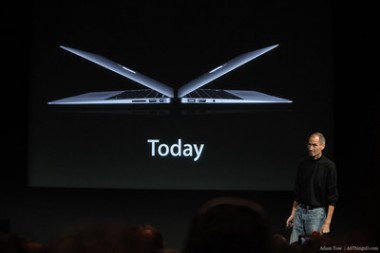
One positive here for Apple is the continued momentum of its platform (Cocoa / iOS). I continue to hear from developers that developing for Android is “a pain”. Fortune had an article on the negatives for Android just yesterday. Meanwhile, the iPad continues to sweep all before it in terms of Tablet sales, and also in terms of being the target for anyone creating a tablet app. The MacBook Air is also creating a new niche of tablet-like-portability-with-laptop-like-flexibility (see for instance Digital Daily on the MacBook Air as Quasi Tablet); and, given the introduction of the Mac Store and the huge and increasing similarities between iOS and MAC Cocoa, the Air is part of Apple’s portability-platform, too.

Platform success means the best apps, and the best mindshare from both consumers and developers. If Apple can find the right way to tackle the mid-market, and continue to broaden distribution in the U.S. and internationally, they could yet win the lion’s share of the smartphone market, even in the face of would-be imitators based on Android.

Comments Off on Product Share vs. Platform Share

Filed under Tech